Wait for it to focus, wait and then there she is, the woman between my legs. I see her face, her reassuring smile.
My voice fractures into a thousand shards, little spinning me, little jagged me. Here a glimpse, there a glimpse, fingers inching closer.
I keep an eye on the table to the right, watch the line where the wall meets the ceiling. I don’t trust them, don’t trust lines but then again, I don’t care. Not now.
Morning started in the thin pink ethnic t-shirt that took me under the tree I’ll pass by later. I’m sure the bole of it remembers me, it showed me how to bend into the nature. I said I’d do whatever it takes and I did.
Now I come to think of it, it was the pale green embroidered t-shirt, did I change in the morning, now I’m not sure? Either way trees came and went. They wheeled me inside.
Later. Round about now a new ceiling watched me sleep despite the spasms.
You know when you can hear your mother inside you saying that you have to rest? But you know and she knows that you can’t, not now. Well, not just yet.
And your mother’s face is around you with that look, that understanding that you can’t stop. And she swallows hard, keeps it all in, and like her, you do just the same.
And she sits alongside you in the silent dawning kitchen, she makes the tea for you while you let yourself feel feelings for a while.
She wears that old green dressing gown that kept her warm and she shuffles with her life-lived feet. She knows. And under her dressing gown, her body that made you, is reminding you that you can do this, that you have the strength.
You lean into the worktop, the oak takes your weight. It’s quiet in here, apart from your sniffing and the soft sounds of your mother busying herself around you.
She walks alongside you keeping you up.
She passes the tea cup to you. She knows everything you feel.
You drink up, wipe your eyes.
Do it all again, she whispers.
You can stop soon. just not today. Your mother on the inside, charging you up. again.
The water seems kinder today or maybe I’m just more aware of it that’s all. I wash my arms with consciousness as though cleansing myself from within. It helps.
I wonder about the woman in the black dress . It looked black though its print was of tiny bright flowers, red maybe orange. She passed me on day one, eyes pooling, brimming, hand to nose and mouth as she rushed out. I couldn’t hug her but the feeling pulsed up through me. It would have startled her anyway if I’d reached out, she had enough to deal with. She spilled over as I just about kept it in.
That was last week.
I wonder about her this morning. Is she having a shower, does she have time for a bath, is she thinking in the water like I am? Is she held in its amniotic fluid, giving her strength for another day.
Maybe she has a quick wash, doesn’t bother with make-up, or maybe she needs it as a shield against the world.
Does she feel the tightness in her chest, her tummy flip as she sanitises her hands and pushes through the heavy doors? Has she forgotten she’s even got a body, is she churning in her head, like me.
The water is kinder today, present, healing, it tells me to slow down as it drips off my skin. Little spheres of surface tension, swirling rainbows dance inside. I send them out to the woman in the black dress, I hope she’s still holding up, like me.
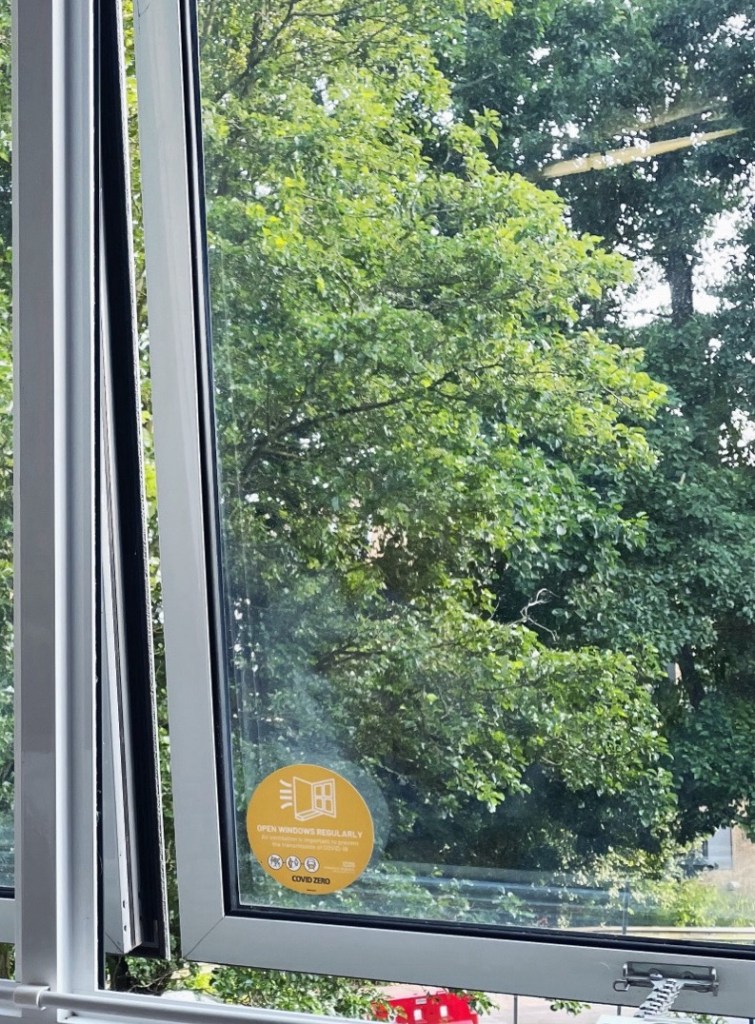
Now there’s a tree watching over the bed, birds scrabbling for food, people darting in and out the Costas just off to the right and if they looked up from their latte they’d see me in the window looking out.
I didn’t like yesterday’s room though, felt too far tucked away, almost a sense of punishment, of neglect. Broken thinking on my part, of course. Tiredness doesn’t help.
Of course the care was on point and Senior Sister Gemma enfolded me with her reassuring London tones, her voice and her words and her ways. She called me darlin’ and we joked about the room upgrade. She should have been pulling pints but she was pushing beds instead and I was grateful .
And when the upgrade came, when trees were administered, when the relief of natural light came into view, I relaxed (a little.)
A ward with a window over green and the bole of the tree stands guard, steady, constant, dependable bark that’s been there a hundred years watching people change.
I feel like I’ve been there a hundred years but it’s only day seven or is it eight?
Maybe that’s why the previous room took me down, floored me with an echo of late pregnancy, of no privacy, of people poking and me hanging on. Propped up, out of time with a job to do, concerned faces, waiting, willing. Praying.
I think that’s it, the silent magnolia walls, the speckled ceiling, just a little too high for my liking and a view, (if you can call it that,) over the scrag end of the buildings.
Still, that’s not now.
I’d better get up, I’ve got a job to do. I hope Gemma’s on today. I like her long black pony tail. When she walks, it swings like a metronome on her back, keeping me steady with her rhythm.
Is it day six or seven, I’m not sure? Not that it matters. Time has rolled in on itself. There aren’t hours, there are interruptions, people doing things, bringing things, taking, giving, adding observations to their charts. There’s no natural light, everything’s in suspension.
I walk the corridor in my mind, through the big old doors, nod to the receptionist, past the childrens’ drawings of a lion. The lion smiles, you know, the way they do? Secure in their strength, protected by a massive mane of gold. I think he waves a paw at me, not sure. And up the slight incline almost like a ramp boarding a ship to somewhere else, a sense of entering a different world.
The artwork on either side demands attention but I rush past, abstractions blur, birds and flowers shrug at me. They don’t care, they’ll be there on the way out, suspended in gouache, captured moments that mean the world to someone.
My feet keep walking, step after step, soles squeak on their lino, sometimes heels click, depending on which shoes I’m wearing. It doesn’t matter either way so long as I keep going. Past the towering stacks of SHEETS and BLANKETS covered in thin plastic. They’re organised in here. I’m back in the machine, cogs turn, people sometimes smile, sometimes avoid your eye. Everyone churning, focused.
I walk the corridor in my mind. It’s 06:08. I’ll walk it for real again soon. I’ll say hello to Leo as I go past, Maybe I’ll imagine that I’m a lion too.
Do you know how much I hate the relative’s room? I know hate is a strong word, maybe I resent it, is that better? Of course, I’m so grateful for it too, its functional furniture, its token flowers on the windowsill as if to say don’t worry, things will bloom again.
Do you know how much I feel for The Lady from Upstairs? She visits us twice a day, in her clouds of dementia, has a little walk with the nurse who tells her she can’t go any further. That’s the men’s ward, she repeats but The Lady from Upstairs doesn’t care, she protests, she says hello regardless and we wave back until she turns around to go again. She’s on repeat – as am I.
It makes me sad, it makes me grateful, it rams home our essential life affirming interconnectedness and all I want to do is bundle her up in my arms and hug her until all the things she struggles with will seep away, until she’s a young lithe girl again, giddy, in fresh love and her mind is as crystal clear as her young eyes.
I turn away, I look towards the bed I sit by. I want to do the same for all the patients. I want to make us all ok, but I can’t.
And on the way in for the nth time this week, up the endless polished corridors, I passed the brand new parents, the father clutching a warm thing to his chest, he murmurs ‘it’s ok young one,’ as as I go past, although I know he’s not talking to me. And as I reach the place where I turn off, where I brace yet again, an elderly man pushes his wife in a wheelchair, and I feel the invisible threads between us all. The elderly woman and baby swap places, meld into each other and I can’t tell where either begin or end.
This morning I took time out in the relative’s room, I looked out past the sprig of freesias to the claustrophobic slabs of brick. I know this place. I’ve got form.
I throw my damp tissues into the bin and head back to the ward. The Lady from Upstairs will be back to see us soon. I hope she feels happy in her world, somehow, in some way.
Why is everything so blue in here? I guess it’s designed to bring calm but it doesn’t really work. I don’t like blue concertina curtains. They unnerve me.
If I could say anything to her, I’d tell her to still wear the Mary-Jane’s, they suited her. Their implied sweetness that belied her strength. In any case she’d never believe the steps she’d take beyond the pub in Wooten Wawen even if I told her.
And yes, the bells jingled on her skirt, noting how their sound hangs in the air, looping around, even now and what is it about the black and white Indian cotton that always comes to mind? Is it the waft against her legs, is it the foreshadowing of the woman in the making? Yes probably.
And if I could take her hand and tell her to choose a different skirt, one with less sense of contrast, would she? I doubt it. Did she buy that skirt and wear it because she had to, because she would think about it now, now when the black and white contrasts had become her life?
She would always choose that skirt and in an August car park it would billow out in the scented summer night. Billow out, like the curve of a balloon in a hot Summer sky. But then, you knew that didn’t you?
If I could say anything to her, I’d say don’t worry. Just wear the shoes, you’ll be alright. Believe me. And she does.
Following myself along is sometimes confusing. I do get lost at times. I start out down by the river by the ancient bridge. I wonder how I’m connected to the woman in the photo from 1905, with her skirt brushing the pavements. I jump-cut, I fly.
But I know how I’m connected to the woman in 1962, sipping strong tea, exhausted and her brand new warm pink baby has a heavy head, it makes her arm ache, her thin arms that would entangle mine on-top of Pendle Hill, years later. You know the hill? That hill, her arms, that baby, this life.
You know how it goes. So I keep following myself. The river flows over rocks, timeless. There are words in the river. I wander by waters. Fluid.
In her mind she organised the day, hid little treats around the house, his favourite things and she baked. Tiny cakes and tiny biscuits as though they lived in a magical world. She iced everything with silver letters, anagrams of their favourite words and she watched him as he ate. One letter after another, sugared syntax on his tongue and he was happy.
She loved to bake, she liked to feed him and later she set up the annual treasure hunt. Clues were presented in unusual places and the more he searched the younger he became.
And the younger he became, the more they merged. Together, hand in hand they moved back in time until he caught her eye by the school gate and she looked down. And up. She looked back up at him and smiled. They walked towards the bottom end of town, to the park by the swimming pool and round the back, under the bridge, in the shadows he pulled her into him and kissed her. It was the most obvious thing and somehow as their lips collided it shuddered through the years as though she was an older woman looking back.
They walked on, arms linked, talking nonsense, laughing. And at the turning for her road he said he’d meet her in morning, he might be a little late.
‘Wait here for me?’ he said. And she nodded, ‘I’ll be waiting,’ kissed his cheek and turned to go then stopped.
‘Oh, I made lemon drizzle today in food-tech, got loads, d’you want some?’ and she pulled the tupperware out from her bag, flicked the lid off and gave the cake to him, soft and moist, sugared in tiny stars.
She pushed it into his mouth with pen stained fingertips, it melted on his tongue and he swallowed.
‘Pretty good,’ he said. ‘Yeah, pretty good,’ he smiled, and it was and she was and they were.




 Janey L Foster